
PSA (prostate-specific antigen) is a protein produced by the prostate gland that has been widely used as a blood marker for prostate cancer screening.
High False Positive Rate
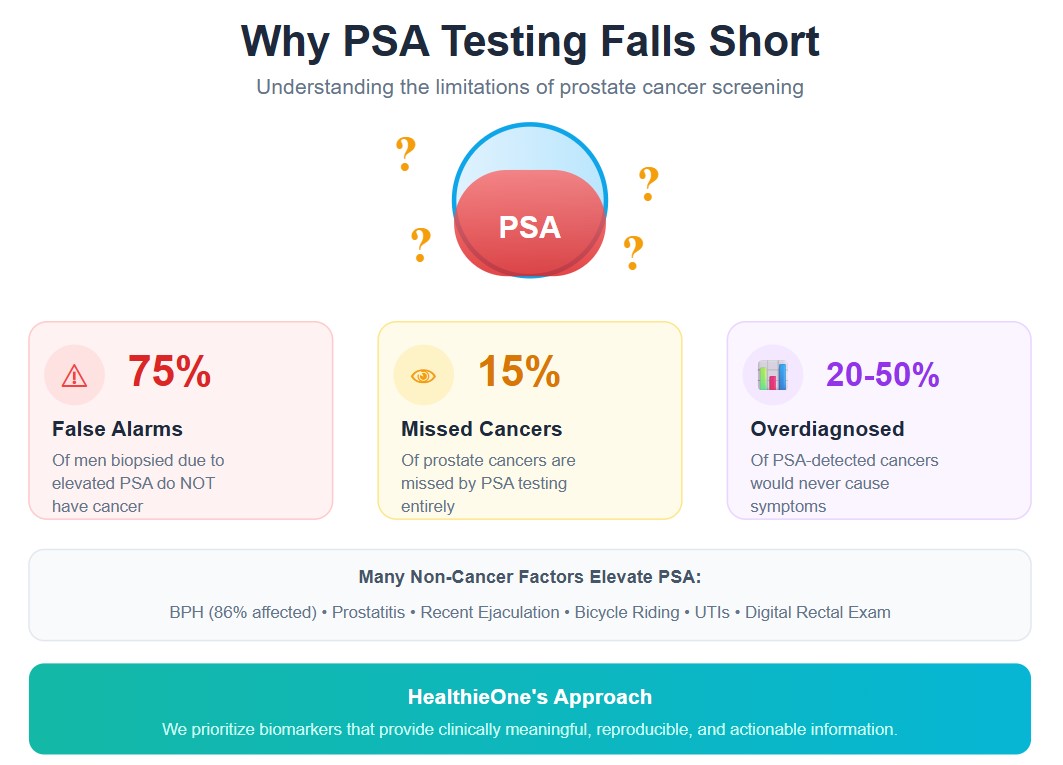
PSA is a highly sensitive but relatively non-specific screening tool, as both benign and malignant conditions elevate the serum marker.[1] According to the National Cancer Institute, "about 6%–7% of men have a false-positive PSA test on any given screening round, and only about 25% of men who have a biopsy due to an elevated PSA level are found to have prostate cancer."[2] The U.S. Preventive Services Task Force recommended "Screening offers a small potential benefit of reducing the chance of death from prostate cancer in some men. However, many men will experience potential harms of screening, including false-positive results that require additional testing and possible prostate biopsy; overdiagnosis and overtreatment; and treatment complications, such as incontinence and erectile dysfunction."[3] "This is known as overdiagnosis, and follow-up of large randomized trials suggests that 20% to 50% of men diagnosed with prostate cancer through screening may be overdiagnosed." [3].
PSA levels can be elevated by many conditions unrelated to cancer, leading to unnecessary anxiety, follow-up testing, and invasive biopsies. Common causes of elevated PSA include:
- Benign prostatic hyperplasia (BPH): Studies show that up to 86% of individuals with benign prostatic hyperplasia may have elevated levels of serum PSA.[1]
- Prostatitis: "acute prostatitis, benign prostatic hyperplasia, after catheter manipulations, etc".[1,4]
- Recent ejaculation: "Ejaculation can increase PSA concentration in approximately 87% of individuals, with levels remaining elevated for up to 48 hours".[5,6]
- Bicycle riding: "Cycling causes an average 9.5% increase in tPSA, in healthy male cyclists ≥50 years old, when measured within 5 minutes post cycling".[7]
- Digital rectal exams: "Some procedures done in a doctor’s office that affect the prostate, such as a prostate biopsy or cystoscopy, can raise PSA levels for a short time."[8]
- Urinary tract infections [4]
False Negatives
A normal PSA result does not rule out prostate cancer. "PSA testing misses about 15% of prostate cancers."[9] Some prostate cancers, including certain aggressive types, do not significantly elevate PSA levels, potentially providing false reassurance when further evaluation may be warranted.
Poorly differentiated prostate cancer cells may lose their ability to express PSA. Case reports document metastatic prostate cancer with high-grade Gleason scores (8-10) presenting with PSA levels below 0.1 ng/mL.[10] The phenomenon of prostate cancer progression without concomitant PSA elevation may be explained by the proliferation of cell lines that either cannot produce PSA or have lost their ability to express it.[10]
Poor Specificity
PSA alone cannot distinguish between cancer and benign conditions. An elevated reading indicates something is happening in the prostate, but not what.[2,4] This limitation often leads to a cascade of additional testing, including biopsies that may ultimately reveal no cancer.
According to the National Cancer Institute, PSA concentration is a continuous parameter with no universally accepted threshold value for prostate cancer diagnosis.[4] It cannot detect the aggressiveness of tumors and can lead to overdiagnosis—it has been estimated that between 20% and 50% of prostate cancers detected through PSA screening are over-diagnosed.[4]
Our Position
At HealthieOne, we prioritize biomarkers that provide clinically meaningful, reproducible, and actionable information. We believe testing should reduce uncertainty, not create it. Given PSA's well-documented limitations in specificity and its potential to generate more questions than answers, we do not include it in our panels.
For prostate health concerns, we encourage individuals to have informed discussions with their healthcare providers about the benefits and limitations of PSA screening, particularly in the context of their personal risk factors, age, and family history.
References
- National Center for Biotechnology Information (NCBI) - StatPearls. Prostate-Specific Antigen. September 2024. "PSA is a highly sensitive but relatively nonspecific and imprecise screening tool... Studies show that up to 86% of individuals with benign prostatic hyperplasia may have elevated levels of serum PSA." https://www.ncbi.nlm.nih.gov/books/NBK557495/
- National Cancer Institute. Prostate-Specific Antigen (PSA) Test Fact Sheet. "About 6%–7% of men have a false-positive PSA test on any given screening round, and only about 25% of men who have a biopsy due to an elevated PSA level are found to have prostate cancer." https://www.cancer.gov/types/prostate/psa-fact-sheet
- U.S. Preventive Services Task Force. Prostate Cancer: Screening Recommendation. May 2018. "One major trial in men screened every 2 to 4 years concluded that, over 10 years, more than 15% of men experienced at least 1 false-positive test result." https://www.uspreventiveservicestaskforce.org/uspstf/recommendation/prostate-cancer-screening; https://jamanetwork.com/journals/jama/fullarticle/2680553
- Defined Health / PMC. Factors associated with false negative and false positive results of prostate-specific antigen (PSA) and the impact on patient health: Cohort study protocol. 2019. "It is not a specific PCa biomarker, as it can be high in other circumstances (such as acute prostatitis, benign prostatic hyperplasia, after catheter manipulations, etc)... It has been estimated that between 20 and 50% of PCa are overdiagnosed." https://www.ncbi.nlm.nih.gov/pmc/articles/PMC6783167/
- Öztürk Mİ, et al. Effect of ejaculation on Serum Prostate-Specific Antigen concentration. Turkish Journal of Urology. 2016. "In the study group, changes in tPSA and fPSA levels after ejaculation were found statistically significant." https://pmc.ncbi.nlm.nih.gov/articles/PMC4920563/
- Herschman JD, Smith DS, Catalona WJ. "Ejaculation increases the serum prostate-specific antigen concentration." Urology. 1996 Apr;47(4):511-6. https://pubmed.ncbi.nlm.nih.gov/8638359/
- Mejak SL, Bayliss J, Hanks SD. "Long distance bicycle riding causes prostate-specific antigen to increase in men aged 50 years and over." PLoS ONE. 2013;8(2):e56030. https://pmc.ncbi.nlm.nih.gov/articles/PMC3572135/
- American Cancer Society. Prostate Cancer Screening Tests. "Some studies have suggested that a digital rectal exam (DRE) might raise PSA levels slightly... some doctors advise having the blood drawn for the PSA before having the DRE." https://www.cancer.org/cancer/types/prostate-cancer/detection-diagnosis-staging/tests.html
- Canadian Cancer Society. Prostate-specific antigen (PSA) test. "PSA testing misses about 15% of prostate cancers." https://cancer.ca/en/treatments/tests-and-procedures/prostate-specific-antigen-psa-test
- Lee DH, et al. Progression of Prostate Cancer Despite an Extremely Low Serum Level of Prostate-Specific Antigen. Korean Journal of Urology. 2010. "Metastatic prostate cancer patients with low PSA levels... presented with a high-grade Gleason score, a low PSA level of less than 0.1 ng/ml... The phenomenon of prostate cancer progression without concomitant PSA elevation may be explained by the proliferation of cell lines that either cannot produce PSA or are poorly differentiated prostate cancer cells that have lost their ability to express PSA." https://pmc.ncbi.nlm.nih.gov/articles/PMC2873892/


No comments yet. Be the first!