
You can’t extend what you can’t measure. Longevity isn’t merely about adding years to life. It’s about understanding what’s happening inside your body at the molecular level and acting on it before disease takes hold, so you can live a longer, healthier life.
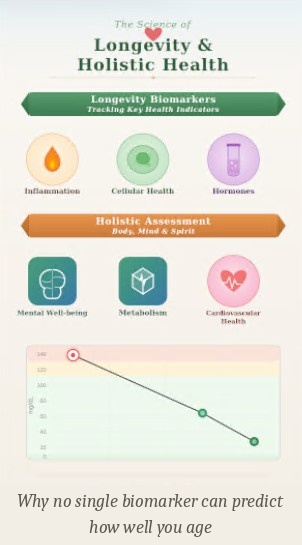
Yet most health testing today captures only a narrow slice of that picture. A standard metabolic panel measures a handful of blood glucose and lipid markers. A hormone panel might cover thyroid and testosterone. An inflammation screen might include CRP alone. Each of these snapshots is useful in isolation, but aging is not an isolated process; it is a systemic cascade that unfolds simultaneously across metabolism, the cardiovascular system, the immune system, the endocrine system, and the machinery of every cell. To truly identify risk, evaluate interventions, and track progress, we need a testing approach that reflects this complexity: a holistic, multi-system assessment that covers every major domain of biological aging.
The science increasingly supports this view. Studies tracked over 25,000 women for 25 years and found that of all the biomarkers examined, small molecule metabolites (citrate, creatinine, homocysteine, and alanine) and inflammatory biomarkers contributed most to lowering mortality risk, followed by triglyceride-rich lipoproteins, body mass index, and insulin resistance. Other pathways, including branched-chain amino acids, high-density lipoproteins, low-density lipoproteins, glycemic measures, and hypertension, had smaller but additive contributions [1]. Crucially, no single class of biomarker explained the majority of risk. It was the breadth of measurement across multiple systems that mattered most.
A separate 35-year Swedish cohort study of over 44,000 individuals reinforced this principle. Those who eventually became centenarians displayed more favorable biomarker values across metabolism, inflammation, and liver function as early as age 65, more than a decade before death, suggesting that the biomarkers we carry in midlife are powerful predictors of exceptional longevity [2]. Again, the distinguishing feature of centenarians was not any single marker in outstanding range, but a favorable profile across multiple biological systems simultaneously.
A 2023 consensus titled “Biomarkers of Aging for the Identification and Evaluation of Longevity Interventions” made the case explicitly: identifying reliable molecular biomarkers of aging is critical for evaluating whether longevity interventions actually work, and metabolomic markers hold particular promise for capturing the multi-system nature of biological aging [3]. Without comprehensive baseline testing across all relevant domains, we are essentially intervening blind: taking supplements, adjusting diets, modifying exercise protocols, and hoping for the best without the ability to verify whether these strategies are shifting our biology in the right direction.
What follows is a review of the five interconnected biological systems that longevity researchers consistently identify as the essentials of healthy aging, and the specific biomarkers within each that the peer-reviewed literature has linked to mortality, disease risk, and exceptional longevity.
1. Metabolic Health: Beyond Glucose and A1C
Metabolic dysfunction is the silent engine of aging. It drives everything from cardiovascular disease to neurodegeneration. Yet standard screening captures only the crudest measures, namely fasting glucose and HbA1c, while missing the more granular metabolic signals that predict disease years before a diagnosis.
A holistic metabolic assessment should include glucose regulation, mitochondrial efficiency, energy substrate utilization, and insulin resistance. Key markers that go beyond the standard panel include:
1,5-Anhydroglucitol (1,5-AG) detects glycemic excursions, specifically the glucose spikes that HbA1c averages away. In a prospective study of 11,106 participants in the Atherosclerosis Risk in Communities (ARIC) cohort followed for 20 years, low 1,5-AG was significantly associated with coronary heart disease, heart failure, and death, with the strongest associations observed even after adjusting for HbA1c, demonstrating that glycemic variability carries cardiovascular risk beyond what average glucose control reveals [4]. A separate ARIC analysis confirmed that 1,5-AG captures risk information associated with hyperglycemic excursions, particularly in persons with diagnosed diabetes, even after adjustment for HbA1c [5]. A 2024 review further established that 1,5-AG has clinical value not only for screening, diagnosing, and managing diabetes but also for predicting and assessing its complications [6].
Insulin Resistance Screening (TyG Index) and Metabolic Score for Insulin Resistance (METS-IR) provide insulin resistance screening without requiring fasting insulin measurements, which are notoriously variable between assay platforms. In the PURE study of 141,243 individuals across 22 countries followed for a median of 13.2 years, the highest TyG index tertile was associated with significantly greater incidence of cardiovascular disease (HR 1.21), myocardial infarction (HR 1.24), stroke (HR 1.16), and type 2 diabetes (HR 1.99), establishing it as a robust, accessible surrogate for insulin resistance [7].
Complete Krebs cycle intermediates (citric acid, succinic acid, fumaric acid, malic acid, and others) reveal how efficiently mitochondria are producing energy, providing a window into the cellular metabolic machinery that standard panels completely ignore. These metabolites are now understood to function not merely as biosynthetic intermediates but as signaling molecules that control chromatin modifications, DNA methylation, the hypoxic response, and immunity, with their dysregulation increasingly linked to aging and disease [8].
Ketone bodies (beta-hydroxybutyrate, acetoacetic acid) indicate whether the body is effectively utilizing fat as a fuel source, a metabolic flexibility marker increasingly recognized as relevant to metabolic resilience and aging. Beta-hydroxybutyrate in particular is now understood as a signaling metabolite that inhibits class I histone deacetylases, links dietary status to epigenetic gene regulation, and activates oxidative stress resistance pathways relevant to diseases of aging and longevity [9].
Centenarian studies consistently confirm that preserved metabolic function is a hallmark of exceptional longevity. Those who reach 100 display lower glucose and more favorable metabolic profiles compared to their shorter-lived peers, often measurable decades before death [2].
2. Cardiovascular Health: The Markers That Actually Predict Risk
Heart disease remains the leading cause of death worldwide, yet most cardiovascular screening still relies on a basic lipid panel (total cholesterol, LDL-C, HDL-C, and triglycerides). The longevity literature has identified a far more predictive set of 40 or more cardiovascular biomarkers that capture risk with substantially greater precision.
Apolipoprotein B (ApoB) is emerging as the single best lipid marker for cardiovascular risk. A 2024 study in the Journal of the American College of Cardiology analyzed 95,108 adults from the Copenhagen General Population Study and demonstrated a dose-dependent association between excess ApoB and increased risk of myocardial infarction, atherosclerotic cardiovascular disease, and all-cause mortality across the entire LDL-C spectrum [10]. The National Lipid Association’s 2024 Expert Clinical Consensus confirmed that “ApoB is superior to LDL-C in risk assessment both before and during treatment with lipid-lowering therapy” [11].
Lipoprotein(a) is approximately 90% genetically determined and is now recognized as an independent causal risk factor for atherosclerotic cardiovascular disease. A 2024 pooled analysis of five major U.S. longitudinal studies (MESA, CARDIA, JHS, Framingham, and ARIC) encompassing 27,756 participants with an average 21-year follow-up found that individuals with Lp(a) levels at or above the 90th percentile had a 46% higher risk of atherosclerotic cardiovascular events, independently of LDL-C levels [12]. A participant-level meta-analysis of 27,658 participants across six placebo-controlled statin trials confirmed that Lp(a) and LDL-C confer cardiovascular risk independently of each other [13]. Current cardiovascular guidelines now recommend measuring Lp(a) at least once in a lifetime [14].
Homocysteine is a potent independent predictor of mortality. A meta-analysis of 12 prospective studies encompassing 23,623 subjects found that those with the highest homocysteine levels had 66% higher coronary heart disease mortality, 68% higher cardiovascular mortality, and 93% higher all-cause mortality compared to those with the lowest levels [15]. A dose-response meta-analysis including 27,737 individuals confirmed a linear relationship: each 5 µmol/L increment in homocysteine was associated with an 80% increase in all-cause mortality risk [16]. A 2024 study further showed that plasma homocysteine is associated with subclinical myocardial injury and cardiovascular mortality even in individuals without diagnosed cardiovascular disease [17]. The 2024 JAMA study also identified homocysteine as one of the strongest small-molecule mediators of mortality risk [1].
TMAO (Trimethylamine N-oxide) is a gut microbiome-derived metabolite increasingly recognized as a cardiovascular risk factor. In the Multi-Ethnic Study of Atherosclerosis (MESA), a community-based cohort of 6,785 adults, plasma TMAO levels were positively associated with both all-cause and cardiovascular mortality, especially deaths due to cardiovascular and renal disease [18]. A nested case-control study within the EPIC-Norfolk cohort showed that “elevated plasma levels of the gut microbe-dependent metabolite TMAO, and its nutrient precursor choline, predict incident risk for cardiovascular disease development independent of traditional risk factors” [19]. A 2024 case-control study confirmed TMAO’s association with atherosclerosis severity and multiple-vessel coronary disease [20].
Omega-3 fatty acid profile (DHA, EPA, DPA) and the EPA/AA ratio represent an emerging cardiovascular risk dimension. In the TREAT-CAD study of 617 coronary artery disease patients followed for over four years, those with a low baseline EPA/AA ratio (≤0.4) who received EPA supplementation had significantly lower cardiovascular death compared to untreated patients, and an achieved EPA/AA ratio above 1.2 predicted reduced all-cause mortality [21].
ADMA (Asymmetric dimethylarginine) and the arginine/ADMA ratio are markers of endothelial dysfunction. In a study of 3,320 community-dwelling adults from the Framingham Offspring cohort, ADMA and the ratio of arginine to ADMA were significantly associated with all-cause mortality and incidence of cardiovascular disease [22].
3. Inflammation: The Quiet Accelerator of Aging
Chronic low-grade inflammation, sometimes called “inflammaging,” accelerates every degenerative process in the body. The concept, first described by Franceschi et al., posits that healthy aging and longevity are the result not only of a lower propensity to mount inflammatory responses but also of efficient anti-inflammatory networks, which in normal aging fail to fully neutralize the inflammatory consequences of a lifelong antigenic burden. This global imbalance can be a major driving force for frailty and common age-related pathologies [23].
A 2019 Nature Medicine perspective expanded this framework, describing how certain social, environmental, and lifestyle factors promote systemic chronic inflammation (SCI) that can lead to cardiovascular disease, cancer, diabetes mellitus, chronic kidney disease, non-alcoholic fatty liver disease, and autoimmune and neurodegenerative disorders, collectively the leading causes of disability and mortality worldwide [24]. Comprehensive inflammation assessment therefore requires markers that capture this process from multiple angles.
C-Reactive Protein (CRP): The English Longitudinal Study of Ageing tracked 2,437 individuals aged 47 to 87 over a decade and found that those with rising CRP trajectories had significantly worse outcomes in physical functioning, cardiometabolic health, respiratory function, mental health, and a composite healthy aging index compared to those with stable-low CRP [25]. Studies in the oldest-old from Chinese longevity areas and the PolSenior study have confirmed that elevated CRP and IL-6 are consistently associated with higher all-cause mortality, even among those who have already reached advanced age [26, 27].
Composite inflammation indices: Systemic Immune-Inflammation Index (SII), Systemic Inflammation Response Index (SIRI) and Aggregate Index of Systemic Inflammation (AISI), derived from complete blood count differentials, provide a multi-dimensional inflammation picture that single markers like CRP cannot capture. In a 20-year follow-up of 42,875 U.S. adults from NHANES, individuals in the highest quartiles of both SII and SIRI had significantly increased risks of all-cause and cardiovascular mortality after adjusting for confounders, with the risk of all-cause death particularly elevated in adults aged 60 and older [28].
The kynurenine pathway (kynurenine, kynurenic acid) links inflammation directly to neurological aging. When the immune system is chronically activated, tryptophan is increasingly shunted into the kynurenine pathway rather than toward serotonin synthesis. A 2025 systematic review and meta-analysis of 98 studies confirmed that kynurenine pathway metabolites are altered in patients with cognitive impairment and dementia, with an elevated kynurenine-to-tryptophan ratio consistently observed in peripheral blood of Alzheimer’s disease patients compared to cognitively healthy controls [29].
Glutathione (reduced): The body’s master antioxidant and a direct measure of oxidative stress defense. Elderly subjects have been shown to have markedly lower red blood cell glutathione concentrations, nearly half those of younger adults, due to a significant reduction in glutathione synthesis rate, accompanied by elevated plasma oxidative stress and oxidant damage markers [30]. Reduced glutathione levels reflect the body’s capacity to neutralize free radicals and protect against the cumulative oxidative damage that is a hallmark of aging.
4. Hormonal Balance: The Longevity Clock
Hormonal decline is one of the most measurable, and most actionable, aspects of aging. Yet standard hormone panels typically measure only a few hormones in isolation. A comprehensive longevity assessment requires the full hormonal landscape: adrenal hormones, sex hormones, neurosteroids, and their ratios.
DHEA and DHEA-S: DHEA-S, the most abundant steroid hormone in circulation, peaks between ages 20 and 30 and declines approximately 2 to 5% per year thereafter [31]. The DHEAge Study, a double-blind, placebo-controlled trial of 280 healthy individuals aged 60 to 79, demonstrated that DHEA supplementation restored youthful DHEA-S concentrations and produced measurable improvements in bone turnover, skin status, and libido, particularly in women over 70 [31]. A meta-analysis of six prospective studies enrolling 6,744 elderly individuals found that those with the lowest circulating DHEA-S levels had a 46% higher risk of all-cause mortality and a 49% higher risk of cardiovascular mortality compared to those with higher levels [32]. The PAQUID prospective cohort followed elderly subjects for 8 years and found that in men, lower DHEA-S was significantly associated with increased mortality, with particularly striking risk elevations in men under 70 (relative risk = 6.5) [33]. DHEA-S levels are negatively correlated with serum IL-6 concentrations in aging men and women, directly linking this hormone to the inflammatory processes that drive aging [34]. Among the oldest-old, those with the highest functional status consistently show the highest DHEA-S levels [35].
Cortisol/DHEA-S Ratio: While DHEA-S declines sharply with age, cortisol levels remain relatively stable, creating a progressively unfavorable ratio. In a 15-year prospective study of 4,255 men from the Vietnam Experience Study, a higher cortisol-to-DHEA-S ratio was significantly associated with all-cause, cancer, and other medical cause mortality after adjustment for confounders, and proved a stronger predictor than either hormone alone [36]. This ratio illustrates a central principle of holistic assessment: the relationship between biomarkers often conveys more information than any single marker in isolation.
Pregnenolone: The “mother hormone” from which all steroid hormones are derived. In addition to serving as the precursor for cortisol, progesterone, testosterone, the estrogens, and DHEA, pregnenolone is one of the most abundant neurosteroids in the brain, where it modulates myelination, neurotransmission, and neuroinflammation, all functions that directly impact cognition and neurological aging [37].
Complete sex hormone profile: Including testosterone, estradiol, estrone, estriol, progesterone, DHT, and androstenedione. Aging is associated with the loss of sex hormones in both men (andropause) and women (menopause), and deficiencies in multiple anabolic hormones have been shown to predict health status and longevity in older persons, with reductions in testosterone triggering declines in muscle mass and bone density, and loss of estradiol contributing to cardiovascular risk, osteoporosis, and cognitive decline [38].
5. Cellular and Tissue Health: Where Aging Really Happens
Aging begins at the cellular level: in your DNA repair machinery, your nucleotide pools, your methylation pathways, and the metabolic signals exchanged between your gut microbiome and your tissues. As the 2023 Cell consensus paper emphasized, metabolites related to nucleotide metabolism, oxidative stress defense, and gut-derived antioxidants are increasingly recognized as potential signatures of exceptional longevity [3]. Measuring these markers is essential for anyone seeking to evaluate whether longevity interventions are actually shifting cellular biology in a favorable direction.
Complete nucleotide metabolism (adenine, guanine, cytosine, thymine, uracil, and their phosphorylated forms) reveals DNA repair capacity and cellular energy reserves, the substrates that cells require to maintain genomic integrity and respond to damage. Intracellular deoxyribonucleoside triphosphate concentrations are tightly regulated, and imbalances in these pools have direct genotoxic consequences, driving replication errors, mutagenesis, and mitochondrial DNA mutations that accumulate with aging [39].
S-adenosylhomocysteine: A marker of methylation status directly linked to epigenetic aging, connecting cellular function to the homocysteine pathway already implicated in cardiovascular mortality [15, 16, 17].
Indole-3-propionate: A gut microbiome-derived antioxidant that has been associated with reduced risk of type 2 diabetes in prospective cohort studies. In the Finnish Diabetes Prevention Study, higher indolepropionic acid was inversely associated with T2D incidence and correlated with better insulin secretion, findings replicated in two independent cohorts, and linked to neuroprotective properties in preclinical models of neurodegeneration [39].
Beta-aminoisobutyric acid (BAIBA): An exercise-induced signaling metabolite released by skeletal muscle during physical activity via PGC-1α-dependent valine catabolism. In the landmark study identifying BAIBA as a myokine, it was shown to induce browning of white fat, increase hepatic β-oxidation through a PPARα-mediated mechanism, and inversely correlate with cardiometabolic risk factors in the Framingham Heart Study cohort of 2,067 individuals [40]. BAIBA is, in effect, a molecular readout of exercise benefit, a way to verify at the molecular level whether physical activity is translating into metabolic protection.
The Holistic Assessment
The evidence reviewed above makes one point with striking consistency: aging is not a single-system process, and no single biomarker, no matter how powerful, captures the full picture.
This is particularly important for evaluating longevity interventions. Whether someone is optimizing their diet, adjusting a supplement regimen, modifying exercise protocols, beginning hormone replacement therapy, or experimenting with fasting strategies, the only way to know whether these interventions are working is to measure their impact across every relevant biological system. A glucose marker may improve while an inflammation marker worsens. Hormones may normalize while methylation deteriorates. Without comprehensive, multi-system testing at baseline and follow-up, these trade-offs remain invisible.
HealthieOne Complete was designed to meet this exact need. It is, to our knowledge, the most comprehensive direct-to-consumer health test available for longevity assessment, covering all the essentials of biological aging in a single evaluation, powered by a decade of advanced laboratory expertise.
250+ biomarkers in one test. Most longevity-focused testing services offer 50 to 80 markers and charge more. HealthieOne delivers three to five times the biomarker depth at a fraction of the cost, using its proprietary liquid chromatography tandem mass spectrometry (LC-MS/MS) technology trusted by top medical institutions.
Exclusive markers not available elsewhere. Krebs cycle intermediates, 1,5-AG, GABA, serotonin, melatonin, bile acids, amino acids, fatty acids, complete nucleotide panels. They provide the molecular depth that the longevity literature increasingly shows is necessary for meaningful health assessment.
Built-in follow-up testing. Retesting of abnormal markers along with 170+ markers from HealthieOne Complete, at clinically recommended intervals, so you can track whether your interventions are actually shifting your biology in the right direction.
1:1 doctor consultation included. Your results come with a doctor review to help you understand your data and create an actionable, personalized plan.
Your future self will thank you for what you measure today.
References
[1] Ahmad S, Moorthy MV, Lee IM, et al. Mediterranean Diet Adherence and Risk of All-Cause Mortality in Women. JAMA Network Open. 2024;7(5):e2414322. https://jamanetwork.com/journals/jamanetworkopen/fullarticle/2819335
[2] Murata S, Ebeling M, Meyer AC, et al. Blood biomarker profiles and exceptional longevity: comparison of centenarians and non-centenarians in a 35-year follow-up of the Swedish AMORIS cohort. GeroScience. 2024;46(2):1693-1702. https://doi.org/10.1007/s11357-023-00936-w
[3] Moqri M, Herzog C, Poganik JR, et al. Biomarkers of aging for the identification and evaluation of longevity interventions. Cell. 2023;186(18):3758-3775. https://doi.org/10.1016/j.cell.2023.08.003
[4] Selvin E, Rawlings A, Lutsey P, et al. Association of 1,5-Anhydroglucitol with Cardiovascular Disease and Mortality. Diabetes. 2016;65(1):201-208. https://doi.org/10.2337/db15-0607
[5] Selvin E, Rawlings AM, Grams M, et al. Association of 1,5-anhydroglucitol with diabetes and microvascular conditions. Clinical Chemistry. 2014;60(11):1409-1418. https://doi.org/10.1373/clinchem.2014.229427
[6] Wen Y, et al. The clinical potential of 1,5-anhydroglucitol as biomarker in diabetes mellitus. Frontiers in Endocrinology. 2024;15:1471577. https://doi.org/10.3389/fendo.2024.1471577
[7] Lopez-Jaramillo P, Gomez-Arbelaez D, Lopez-Lopez J, et al. Association of the triglyceride glucose index as a measure of insulin resistance with mortality and cardiovascular disease in populations from five continents (PURE study): a prospective cohort study. Lancet Healthy Longevity. 2023;4(1):e23-e33. https://doi.org/10.1016/S2666-7568(22)00247-1
[8] Martínez-Reyes I, Chandel NS. Mitochondrial TCA cycle metabolites control physiology and disease. Nature Communications. 2020;11:102. https://doi.org/10.1038/s41467-019-13668-3
[9] Newman JC, Verdin E. β-Hydroxybutyrate: A Signaling Metabolite. Annual Review of Nutrition. 2017;37:51-76. https://doi.org/10.1146/annurev-nutr-071816-064916
[10] Johannesen CDL, Langsted A, Nordestgaard BG, Mortensen MB. Excess Apolipoprotein B and Cardiovascular Risk in Women and Men. Journal of the American College of Cardiology. 2024;83(23):2262-2273. https://doi.org/10.1016/j.jacc.2024.03.423
[11] Soffer DE, Marston NA, Maki KC, et al. Role of apolipoprotein B in the clinical management of cardiovascular risk in adults: An Expert Clinical Consensus from the National Lipid Association. Journal of Clinical Lipidology. 2024;18(5):e647-e663. https://doi.org/10.1016/j.jacl.2024.08.013
[12] Wong ND, Fan W, Hu X, et al. Lipoprotein(a) and Long-Term Cardiovascular Risk in a Multi-Ethnic Pooled Prospective Cohort. Journal of the American College of Cardiology. 2024;83(16):1511-1525. https://doi.org/10.1016/j.jacc.2024.02.031
[13] Marston NA, et al. Independence of Lipoprotein(a) and Low-Density Lipoprotein Cholesterol-Mediated Cardiovascular Risk: A Participant-Level Meta-Analysis. Circulation. 2024. https://doi.org/10.1161/CIRCULATIONAHA.124.069556
[14] Nordestgaard BG, Langsted A. Lipoprotein(a) and cardiovascular disease. The Lancet. 2024;404(10459):1255-1264. https://doi.org/10.1016/S0140-6736(24)01308-4
[15] Peng HY, Man CF, Xu J, Fan Y. Elevated homocysteine levels and risk of cardiovascular and all-cause mortality: a meta-analysis of prospective studies. Journal of Zhejiang University-SCIENCE B. 2015;16(1):78-86. https://doi.org/10.1631/jzus.B1400183
[16] Fan R, Zhang A, Zhong F. Association between Homocysteine Levels and All-cause Mortality: A Dose-Response Meta-Analysis of Prospective Studies. Scientific Reports. 2017;7:4769. https://doi.org/10.1038/s41598-017-05205-3
[17] Li T, et al. Homocysteine Metabolism, Subclinical Myocardial Injury, and Cardiovascular Mortality in the General Population. JACC Asia. 2024;4(8):609-620. https://doi.org/10.1016/j.jacasi.2024.05.005
[18] de Oliveira Otto MC, Lemaitre RN, Lai HTM, et al. Trimethylamine N-oxide is associated with long-term mortality risk: the Multi-Ethnic Study of Atherosclerosis. European Heart Journal. 2023;44(24):2192-2201. https://doi.org/10.1093/eurheartj/ehad089
[19] Li XS, Obeid S, Klingenberg R, et al. Plasma trimethylamine N-oxide (TMAO) levels predict future risk of coronary artery disease in apparently healthy individuals in the EPIC-Norfolk Prospective Population Study. American Heart Journal. 2021;236:80-89. https://doi.org/10.1016/j.ahj.2021.01.020
[20] Sun Y, Lin X, Liu Z, et al. Association between plasma trimethylamine N-oxide and coronary heart disease: new insights on sex and age differences. Frontiers in Cardiovascular Medicine. 2024;11:1397023. https://doi.org/10.3389/fcvm.2024.1397023
[21] Abe S, Sugimura H, Watanabe S, et al. Eicosapentaenoic acid treatment based on the EPA/AA ratio in patients with coronary artery disease: follow-up data from the TREAT-CAD study. Hypertension Research. 2018;41:939-946. https://doi.org/10.1038/s41440-018-0102-9
[22] Böger RH, Sullivan LM, Schwedhelm E, et al. Plasma asymmetric dimethylarginine and incidence of cardiovascular disease and death in the community. Circulation. 2009;119(12):1592-1600. https://doi.org/10.1161/CIRCULATIONAHA.108.838268
[23] Franceschi C, Capri M, Monti D, et al. Inflammaging and anti-inflammaging: A systemic perspective on aging and longevity emerged from studies in humans. Mechanisms of Ageing and Development. 2007;128(1):92-105. https://doi.org/10.1016/j.mad.2006.11.016
[24] Furman D, Campisi J, Verdin E, et al. Chronic inflammation in the etiology of disease across the life span. Nature Medicine. 2019;25(12):1822-1832. https://doi.org/10.1038/s41591-019-0675-0
[25] Stevenson A, Akbaraly T, et al. Association of 10-Year C-Reactive Protein Trajectories With Markers of Healthy Aging. The Journals of Gerontology: Series A. 2019;74(2):195-203. https://doi.org/10.1093/gerona/gly028
[26] Chen P-L, Li Z-H, Yang H-L, et al. Associations Between High-Sensitivity C-Reactive Protein and All-Cause Mortality Among Oldest-Old in Chinese Longevity Areas. Frontiers in Public Health. 2022;10:824783. https://doi.org/10.3389/fpubh.2022.824783
[27] Zyczkowska J, Klich-Rączka A, Mossakowska M, et al. Interleukin-6 and C-reactive protein, successful aging, and mortality: the PolSenior study. Immunity & Ageing. 2016;13:21. https://doi.org/10.1186/s12979-016-0076-x
[28] Xia Y, Xia C, Wu L, et al. Systemic Immune Inflammation Index (SII), System Inflammation Response Index (SIRI) and Risk of All-Cause Mortality and Cardiovascular Mortality: A 20-Year Follow-Up Cohort Study of 42,875 US Adults. Journal of Clinical Medicine. 2023;12(3):1128. https://doi.org/10.3390/jcm12031128
[29] Choe K, Bakker L, van den Hove DLA, et al. Kynurenine pathway dysregulation in cognitive impairment and dementia: a systematic review and meta-analysis. GeroScience. 2025. https://doi.org/10.1007/s11357-025-01636-3
[30] Sekhar RV, Patel SG, Guthikonda AP, et al. Deficient synthesis of glutathione underlies oxidative stress in aging and can be corrected by dietary cysteine and glycine supplementation. American Journal of Clinical Nutrition. 2011;94(3):847-853. https://doi.org/10.3945/ajcn.110.003483
[31] Baulieu EE, Thomas G, Legrain S, et al. Dehydroepiandrosterone (DHEA), DHEA sulfate, and aging: Contribution of the DHEAge Study to a sociobiomedical issue. PNAS. 2000;97(8):4279-4284. https://doi.org/10.1073/pnas.97.8.4279
[32] Li L, Yang T, et al. Circulating dehydroepiandrosterone sulfate level and cardiovascular or all-cause mortality in the elderly population: a meta-analysis. Annals of Palliative Medicine. 2020;9(5):3537-3545. https://doi.org/10.21037/apm-20-441
[33] Mazat L, Lafont S, Berr C, et al. Prospective measurements of dehydroepiandrosterone sulfate in a cohort of elderly subjects: relationship to gender, subjective health, smoking habits, and 10-year mortality. PNAS. 2001;98(15):8145-8150. https://doi.org/10.1073/pnas.141065898
[34] Straub RH, Konecna L, Hrach S, et al. Serum DHEA and DHEA-S Are Negatively Correlated with Serum IL-6, and DHEA Inhibits IL-6 Secretion from Mononuclear Cells in Man in Vitro. JCEM. 1998;83(6):2012-2017. https://doi.org/10.1210/jcem.83.6.4876
[35] Ravaglia G, Forti P, Maioli F, et al. Determinants of functional status in healthy Italian nonagenarians and centenarians. JAGS. 1997;45(10):1196-1202. https://doi.org/10.1111/j.1532-5415.1997.tb03769.x
[36] Phillips AC, Carroll D, Gale CR, et al. Cortisol, DHEA sulphate, their ratio, and all-cause and cause-specific mortality in the Vietnam Experience Study. European Journal of Endocrinology. 2010;163(2):285-292. https://doi.org/10.1530/EJE-10-0299
[37] Murugan S, Jakka P, Namani S, et al. The Neurosteroid Pregnenolone Promotes Degradation of Key Proteins in the Innate Immune Signaling to Suppress Inflammation. JBC. 2019;294(12):4596-4607. https://doi.org/10.1074/jbc.RA118.005543
[38] Horstman AM, Dillon EL, Urban RJ, Sheffield-Moore M. The Role of Androgens and Estrogens on Healthy Aging and Longevity. J Gerontol A. 2012;67(11):1140-1152. https://doi.org/10.1093/gerona/gls068
[39] Mathews CK. DNA precursor metabolism and genomic stability. FASEB Journal. 2006;20(9):1300-1314. https://doi.org/10.1096/fj.06-5730rev
[40] de Mello VD, Paananen J, Lindström J, et al. Indolepropionic acid and novel lipid metabolites are associated with a lower risk of type 2 diabetes in the Finnish Diabetes Prevention Study. Scientific Reports. 2017;7:46337. https://doi.org/10.1038/srep46337
[41] Roberts LD, Boström P, O'Sullivan JF, et al. β-Aminoisobutyric Acid Induces Browning of White Fat and Hepatic β-Oxidation and Is Inversely Correlated with Cardiometabolic Risk Factors. Cell Metabolism. 2014;19(1):96-108. https://doi.org/10.1016/j.cmet.2013.12.003


No comments yet. Be the first!