
What's in HealthieOne's Cardiovascular Health Panel
HealthieOne's Cardiovascular Health panel goes far beyond a standard lipid panel, measuring 40+ biomarkers across multiple cardiovascular risk pathways in a single test:
- Lipid Profile & Ratios: Cholesterol Total, LDL, HDL, VLDL, Non-HDL, Total/HDL Ratio, Triglycerides
- Apolipoproteins: Apolipoprotein A1, Apolipoprotein B (Apo B), Apo B/Apo A1 Ratio, Lipoprotein(a)
- Inflammatory & Vascular Markers: C-Reactive Protein, Homocysteine (free), Monocyte-to-HDL Ratio (MHR), Testosterone/C-Reactive Protein Ratio, Trimethylamine N-oxide (TMAO)
- Fatty Acids: Arachidonic Acid, Docosahexaenoic Acid (DHA), Eicosapentaenoic Acid (EPA), Docosapentaenoic Acid (C22:5w3), Docosanoic Acid, Homo-Gamma-Linolenic Acid, Linoleic Acid, Oleic Acid
- Amino Acids & Vascular Function: Arginine, Asymmetric Dimethylarginine (ADMA), Arginine/ADMA Ratio, Citrulline, Carnitine, Taurine, Histamine
- Hormones & Stress Markers: Aldosterone, Cortisol, Cortisone, Corticosterone, Epinephrine, Norepinephrine, Thyroxine, Triiodothyronine
- Other: Chloride, Hematocrit
This comprehensive approach captures not just cholesterol levels, but the inflammatory, metabolic, hormonal, and fatty acid drivers of cardiovascular risk, giving you and your primary healthcare provider a far more complete picture than standard lipid testing alone.
Understanding Cholesterol Concentrations vs. Particle Numbers and Sizes
Cholesterol concentration: how much cholesterol (by weight) is carried in your blood, reported in mg/dL. For example, an LDL cholesterol (LDL-C) result of 120 mg/dL tells you the total amount of cholesterol inside all your LDL particles.
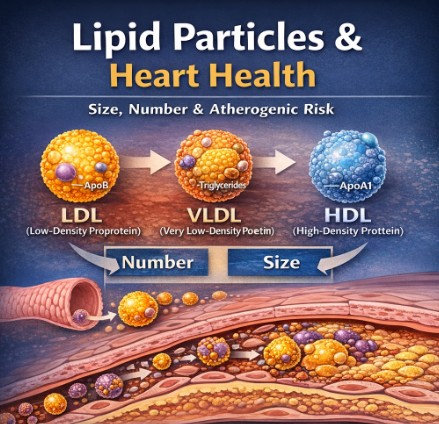
Particles are the carriers: cholesterol travels through your blood inside particles, and these particles vary.
- Particle Number: How many particles are circulating in your blood (not how much cholesterol they carry)
- Particle Size: Whether those particles are small, medium, or large (for LDL, this is often called Pattern A for large particles or Pattern B for small, dense particles)
Two people can have the exact same LDL-C concentration (say, 120 mg/dL), but one might have fewer large particles while the other has many small particles.
So the question is: does knowing your particle number and size change your treatment?
Do LDL/HDL/VLDL Particle Sizes Change Treatment Decisions?
The Short Answer: No.
The American Society for Clinical Pathology's Choosing Wisely recommendation states: "Do not routinely order expanded lipid panels (particle sizing, nuclear magnetic resonance) as screening tests for cardiovascular disease". [1]
Does Particle Size Matter?
You might have heard that small, dense LDL particles are more dangerous than large, fluffy ones. There is some scientific basis for this idea. "Small, dense LDL, which is known to be most closely associated with atherogenesis, is more preferentially glycated in vivo and more susceptible to glycation in vitro than more buoyant LDL. Glycation and oxidation of LDL appear to be intimately linked". [2]
However, a landmark 2025 study of over 207,000 people published in the European Heart Journal found that particle size does not independently predict heart disease. The researchers concluded: "Lipid-related atherosclerotic risk is most accurately reflected by the total count of apoB-P and is largely unaffected by the major particle type (VLDL, LDL) or size" [3]. The study specifically found that "Particle diameter or size subclasses were not associated with CAD after apoB-P adjustment". [3]
Earlier research reached similar conclusions. Allaire et al. (2017) found that "LDL particle size...has not been independently associated with CVD risk after adjustment for other risk factors such as LDL cholesterol, triglycerides, and HDL-C" and concluded that "routine use of information pertaining to particle size to determine and manage patients' risk is not yet justified". [4]
This suggests that having small particles is often just a marker of an underlying metabolic issue (like insulin resistance or high triglycerides) rather than the direct cause of heart disease. Whether you have Pattern A (large particles) or Pattern B (small, dense particles), the treatment approach stays the same: lifestyle changes (diet, exercise, weight management), statin therapy when needed based on your overall cardiovascular risk, and keeping LDL cholesterol as the primary target.
The Key Fact: Every LDL, VLDL, IDL, and Lp(a) particle contains exactly one apoB-100 molecule: no more, no less. This makes apoB a direct count of atherogenic particles circulating in your blood.
What About Particle Number?
The strongest scientific evidence points to particle number, reflected by apoB levels, as more closely tied to cardiovascular risk than particle size.
Genetic studies using Mendelian randomization have confirmed this. Zuber et al. (2021) concluded: "Our agnostic genetic investigation prioritizes ApoB across all datasets considered, suggesting that ApoB, representing the total number of hepatic-derived lipoprotein particles, is the primary lipid determinant of CAD". Notably, "No other measure of cholesterol or triglyceride is consistently selected" when apoB is included in the analysis. [5]
National Lipid Association (NLA) Expert Clinical Consensus states "ApoB has been shown to be superior to LDL-C in risk assessment both before and during treatment with LLT. In individuals, there can be discordance between levels of LDL-C and apoB, as well as LDL-C and non-high-density lipoprotein cholesterol (non-HDL-C), despite high levels of population-wide correlation. When there is discordance between LDL-C and apoB, or LDL-C and non-HDL-C, atherosclerotic cardiovascular disease risk generally aligns better with apoB or non-HDL-C." [6]
Mayo Clinic Laboratories' own ApoB test catalog states: "Apolipoprotein B (ApoB) is the primary protein component of low-density lipoprotein (LDL). LDL contains a variable amount of cholesterol, but each LDL contains exactly one ApoB protein. Therefore, ApoB is a more reliable indicator of circulating LDL compared to LDL cholesterol (LDL-C). "ApoB has been demonstrated to perform equally with LDL particles measured by nuclear magnetic resonance spectroscopy.", specifically "In most studies, both apo B and LDL-P were comparable in association with clinical outcomes. The biomarkers were nearly equivalent in their ability to assess risk for CVD and both have consistently been shown to be stronger risk factors than LDL-C. We support the adoption of apo B and/or LDL-P as indicators of atherogenic particle numbers into CVD risk screening and treatment guidelines. Currently, in the opinion of this Working Group on Best Practices, apo B appears to be the preferable biomarker for guideline adoption because of its availability, scalability, standardization, and relatively low cost." [7].
Mayo Clinic further note that "in 7 different placebo-controlled randomized clinical trials, on-statin reduction of ApoB was more closely related to CVD risk reduction than non-HDL-C or LDL-C" [8]
The 2025 European Heart Journal study also found that Lp(a), another type of apoB-containing particle, "adds additional risk," leading the authors to conclude that "adequate assessment of atherogenic risk from dyslipidemia is best accomplished by consideration of both apoB-P and Lp(a) concentrations". [3]
Important point: Large LDL particles are not harmless. The European Atherosclerosis Society Consensus Panel (2017) established that "the key events in the initiation of ASCVD are the retention and accumulation of cholesterol-rich apoB-containing lipoproteins within the arterial intima" and that "LDL and other apoB-containing lipoproteins <70 nm in diameter...efficiently enter and exit the arterial intima" [9]. This means all LDL particles: large or small, can contribute to atherosclerosis if present in high numbers.
In a prospective study of 27,673 initially healthy women followed for 11 years, during which 1,015 cardiovascular events occurred, lipoprotein particle profiles measured by NMR, concluded, "In this prospective study of healthy women, cardiovascular disease risk prediction associated with lipoprotein profiles evaluated by NMR was comparable but not superior to that of standard lipids or apolipoproteins."
Key Takeaways
1. Particle size testing rarely change treatment. [1].
2. Particle number matters more than size. ApoB "is the primary lipid determinant of CAD" [5], and risk "is largely unaffected by the major particle type (VLDL, LDL) or size" [3].
3. Particle size is not independently associated with risk. "Particle diameter or size subclasses were not associated with CAD after apoB-P adjustment" [3].
4. Large particles are not harmless. All apoB-containing lipoproteins can enter artery walls and contribute to plaque formation [9].
The Bottom Line
The scientific consensus is clear: "Lipid-related atherosclerotic risk is most accurately reflected by the total count of apoB-P and is largely unaffected by the major particle type (VLDL, LDL) or size" [3].
HealthieOne Complete includes the cardiovascular markers that matter most: ApoB, Lipoprotein(a), homocysteine, TMAO, CRP, and omega-3 fatty acids, alongside standard cholesterol, all in one test with 40+ cardiovascular biomarkers. Every test includes a 1:1 doctor consultation to help you understand your cardiovascular risk and next steps.
References
[1] American Academy of Family Physicians. Choosing Wisely: Don't routinely order expanded lipid panels (particle sizing, nuclear magnetic resonance) as screening tests for cardiovascular disease. https://www.aafp.org/pubs/afp/collections/choosing-wisely/316.html
[2] Soran H, Durrington PN. Susceptibility of LDL and its subfractions to glycation. Current Opinion in Lipidology. 2011;22(4):254-261. https://pubmed.ncbi.nlm.nih.gov/21734572/
[3] Morze J, Melloni GEM, Wittenbecher C, et al. ApoB-containing lipoproteins: count, type, size, and risk of coronary artery disease. European Heart Journal. 2025;46(27):2691-2701. https://academic.oup.com/eurheartj/article/46/27/2691/8118996
[4] Allaire J, Vors C, Couture P, Lamarche B. LDL particle number and size and cardiovascular risk: anything new under the sun? Current Opinion in Lipidology. 2017;28(3):261-266. https://pubmed.ncbi.nlm.nih.gov/28460374/
[5] Zuber V, Gill D, Ala-Korpela M, et al. High-throughput multivariable Mendelian randomization analysis prioritizes apolipoprotein B as key lipid risk factor for coronary artery disease. International Journal of Epidemiology. 2021;50(3):893-901. https://academic.oup.com/ije/article/50/3/893/5948819
[6] Daniel E. Soffer, MDa Send email to Daniel.Soffer@pennmedicine.upenn.edu ∙ Nicholas A. Marston, MD, MPHb ∙ Kevin C. Maki, PhDc,d ∙ … ∙ Dave L. Dixon, PharmDm ∙ Christie M. Ballantyne, MDn ∙ Alan T. Remaley, MD, PhDo. Role of apolipoprotein B in the clinical management of cardiovascular risk in adults: An Expert Clinical Consensus from the National Lipid Association. https://www.lipidjournal.com/article/S1933-2874(24)00240-X/fulltext
[7] AACC Lipoproteins and Vascular Diseases Division Working Group on Best Practices, Cole TG, Contois JH, et al. Association of apolipoprotein B and nuclear magnetic resonance spectroscopy-derived LDL particle number with outcomes in 25 clinical studies: assessment by the AACC Lipoprotein and Vascular Diseases Division Working Group on best practices. Clin Chem. 2013;59(5):752-770 https://pubmed.ncbi.nlm.nih.gov/23386699/
[8] Thanassoulis G, Williams K, Ye K, et al. Relations of change in plasma levels of LDL-C, non-HDL-C and apoB with risk reduction from statin therapy: a meta-analysis of randomized trials. J Am Heart Assoc. 2014;3(2):e000759 https://pmc.ncbi.nlm.nih.gov/articles/PMC4187506/
[9] Ference BA, Ginsberg HN, Graham I, et al. Low-density lipoproteins cause atherosclerotic cardiovascular disease. 1. Evidence from genetic, epidemiologic, and clinical studies. A consensus statement from the European Atherosclerosis Society Consensus Panel. European Heart Journal. 2017;38(32):2459-2472. https://academic.oup.com/eurheartj/article/38/32/2459/3745109



No comments yet. Be the first!